
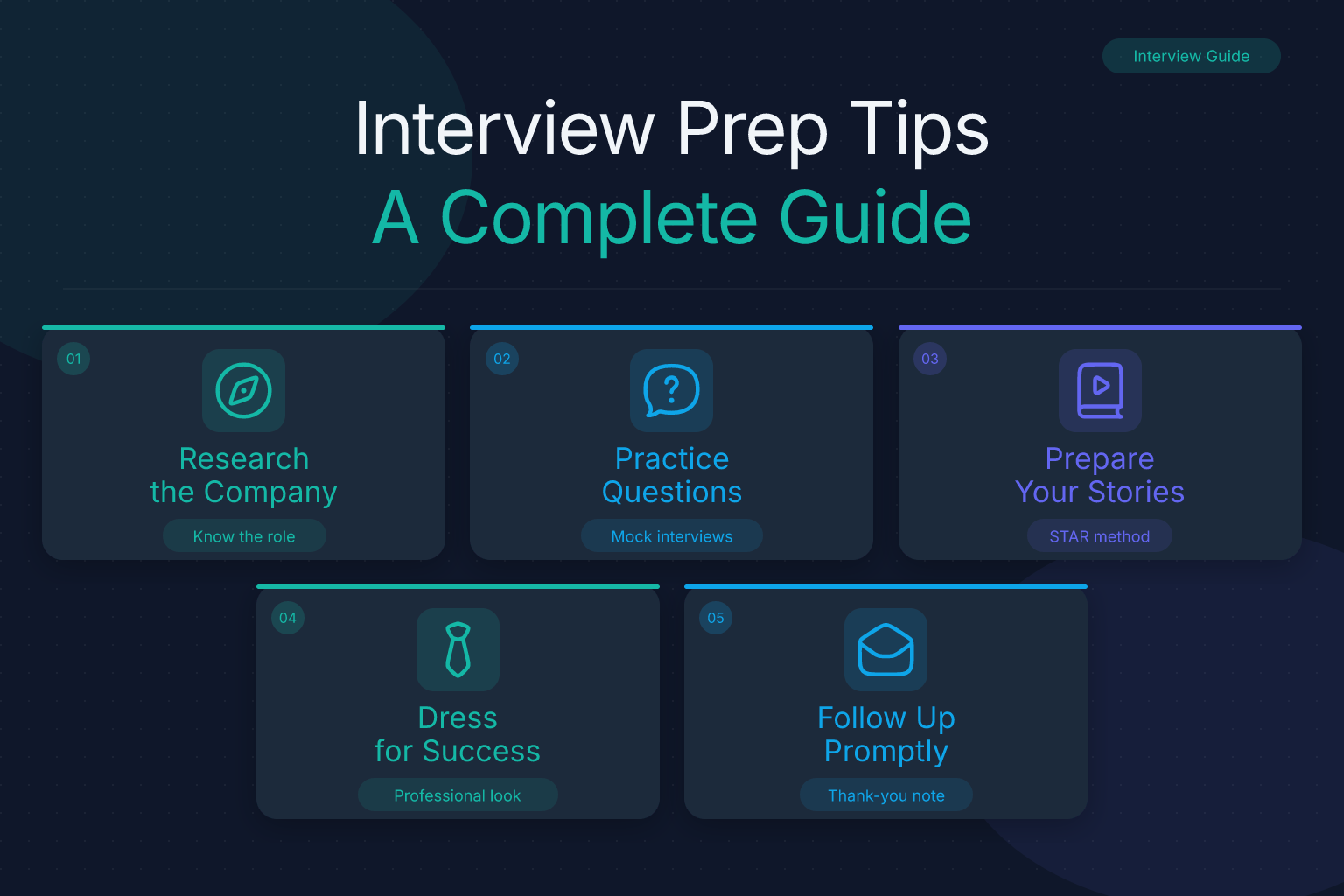
Tips to Prepare for an Interview: A Complete Guide
Landing an interview is a milestone, but the real work begins now. Tips to prepare for an interview can transform nervous energy into a polished, persuasive conversation that gets you hired. Whether you have a week or just a few days, a structured approach makes the difference between a forgettable chat and a memorable performance. This guide walks you through exactly what to do, when to start, and how to tailor your prep for HR, hiring managers, and even CEOs.
| What to Do | Why It Matters | Time |
|---|---|---|
| Research the company and role | Shows genuine interest and helps you tailor answers | 2–3 hours |
| Practice common questions with the STAR method | Builds confidence and structures your examples | 1–2 hours |
| Prepare thoughtful questions to ask | Demonstrates engagement and critical thinking | 30 minutes |
| Review your resume and key achievements | Ensures you can discuss your experience fluently | 1 hour |
| Plan logistics (outfit, tech, route) | Reduces stress and avoids last-minute issues | 1 hour |
When to Start Preparing for an Interview: The First of Many Tips to Prepare for Interview Success
The moment you receive an interview invitation, start preparing. Ideally, give yourself at least a full week. If the interview is in two days, you can still make a strong impression—but you’ll need to prioritize the highest-impact activities and skip the deep dives.
For most professional roles, 5–7 days of steady, focused prep works best. Executive or C-suite interviews often demand two weeks because you’ll need to understand the company’s strategic direction, industry trends, and leadership culture at a much deeper level.
How far in advance should you prepare? A good rule: block time on your calendar the same day you confirm the interview. Even 15 minutes of initial research that evening sets the stage. Cramming the night before leads to shallow, scripted answers that interviewers see through immediately. Spread your prep across several days so your brain can process and refine your stories naturally.
How Much Time You Need to Prepare for an Interview
Total preparation time for a standard interview typically falls between 5 and 8 hours, spread over multiple days. That’s not one marathon session—it’s a series of focused blocks. Here’s a sample schedule for a one-week runway:
- Day 1 (1 hour): Research the company, its products, and recent news. Read the job description again and highlight keywords.
- Day 2 (1.5 hours): Map your achievements to the job requirements. Draft your “tell me about yourself” pitch and outline 5–7 STAR stories.
- Day 3 (1 hour): Practice answering common questions out loud. Record yourself or practice with a friend.
- Day 4 (30 minutes): Prepare 3–5 questions to ask the interviewer.
- Day 5 (1 hour): Refine your stories based on feedback. Do a mock interview if possible.
- Day 6 (30 minutes): Plan logistics—outfit, travel, tech check for virtual interviews.
- Day 7 (30 minutes): Light review, visualize success, and get a good night’s sleep.
If you have less time, compress the schedule but never skip research, story preparation, and logistics. Quality matters more than quantity; 4 focused hours beat 8 distracted ones.
What to Prepare for Any Interview: Core Steps
No matter the role or interviewer, these seven steps form the backbone of effective interview preparation.
- Research the company thoroughly. Go beyond the homepage. Read the “About” and “Mission” pages, scan recent press releases, check their LinkedIn page, and browse employee reviews on Glassdoor. Understand their products, competitors, and any recent challenges or wins. The more you know, the easier it is to connect your answers to their real-world context.
- Analyze the job description. Highlight every required skill and responsibility. For each, identify a specific example from your experience that proves you can deliver. Turn the job description into a checklist of stories you need to have ready.
- Craft your “tell me about yourself” pitch. Structure it as: present role (what you do now), past experience (key achievements that led here), future goals (why this role is the logical next step). Keep it under two minutes. Practice until it sounds conversational, not robotic.
- Practice behavioral questions with the STAR method. Situation, Task, Action, Result. Prepare 5–7 stories that cover leadership, teamwork, problem-solving, failure, and success. For each story, write bullet points—not a script—so you can adapt it to different questions. If you want to generate a bank of tailored practice questions fast, our guide on ChatGPT Interview Prompts: How to Use AI to Prepare shows you how to use AI to simulate realistic interview scenarios.
- Prepare questions to ask them. Aim for 3–5 questions that show you’ve done your homework. Avoid questions easily answered by the website. Instead, ask about team dynamics, success metrics, or recent company initiatives.
- Review your resume. Be ready to expand on every bullet point. If a bullet says “increased sales by 20%,” know the exact strategy, timeline, and metrics behind it. A clean, ATS-friendly resume also gives you confidence—run yours through the free ResumeMate resume score checker to catch any gaps before the interviewer does.
- Plan logistics. For in-person interviews, map the route and plan to arrive 15 minutes early. For virtual interviews, test your camera, microphone, internet connection, and background lighting the day before. (See the virtual interview section below for a full checklist.)
Preparing for an HR Interview: What to Focus On
HR interviews typically screen for culture fit, basic qualifications, salary expectations, and logistics. The conversation may feel less technical, but it’s just as critical—HR often controls whether you advance.
Key areas to prepare:
- Your resume, inside and out. HR will verify dates, titles, and gaps. Have a clear, honest explanation for any employment gap or career pivot.
- A polished “tell me about yourself.” This is almost always the first question. Practice a version that connects your background directly to the company’s needs. For a deeper dive, see our guide on how to answer tell me about yourself in an interview.
- Salary expectations. Research market rates for the role in your location using sites like Glassdoor or Payscale. Have a range ready, and be prepared to explain your reasoning.
- Your reason for leaving (or wanting to leave) your current job. Frame it positively—focus on growth, new challenges, or alignment with the company’s mission. Never badmouth a previous employer.
- Logistical questions. Be ready to discuss your availability, remote vs. on-site preferences, and start date.
HR interviews often last 30–45 minutes. Keep answers concise and forward-looking.
Preparing for a Hiring Manager Interview: Demonstrating Your Value
The hiring manager wants to know one thing: can you solve their problems? This interview dives into your skills, experience, and how you approach real work challenges.
How to prepare:
- Master the STAR method. Behavioral questions dominate hiring manager interviews. For each required competency in the job description, have a STAR story ready. Practice until you can deliver each story in under two minutes without sounding rehearsed. Our guide to the STAR method walks you through building a story bank.
- Prepare for technical or case-based questions. If the role involves specific tools, coding languages, or frameworks, expect to demonstrate your knowledge. Review key concepts and be ready to walk through a recent project step by step.
- Bring a portfolio or work samples if relevant. Designers, writers, and developers should have a few polished examples ready to share and discuss.
- Ask questions that show you’re thinking like a team member. For example: “What’s the biggest challenge the team is facing right now?” or “How do you measure success in this role?”
Hiring manager interviews often run 45–60 minutes. The more you can connect your past work to their current needs, the stronger your case.
Preparing for a CEO or Executive Interview: Thinking Big Picture
When you reach the CEO or another senior executive, the conversation shifts from “can you do the job?” to “how do you think, and will you strengthen our culture?”
What to prepare:
- Deep industry and company research. Read the company’s annual report, investor presentations, and any thought leadership from the CEO. Understand their strategic priorities, market position, and competitive landscape.
- A vision for the role. Be ready to discuss not just what you’d do in the first 90 days, but how your work would support the company’s long-term goals. Frame your experience in terms of business impact.
- Leadership philosophy. Expect questions about how you build teams, handle conflict, and make tough decisions. Prepare stories that illustrate your leadership style.
- Cultural alignment. Executives care deeply about values. Research the company’s stated values and think of examples where you’ve embodied similar principles.
- Insightful questions. Ask about the company’s biggest opportunities, the CEO’s vision for the next five years, or how the industry is evolving. Avoid questions that could be answered by a quick Google search.
CEO interviews are often shorter (30 minutes) but carry enormous weight. Every answer should reflect strategic thinking and a genuine interest in the company’s mission.
How to Prepare for a Virtual Interview
Virtual interviews are now standard for many roles, and they come with their own set of preparation requirements. A flawless in-person presence can be undermined by poor lighting, background noise, or a shaky internet connection.
Tech checklist (do this the day before):
- Test your camera, microphone, and speakers. Use the platform the interviewer will use (Zoom, Teams, Google Meet) to check compatibility.
- Ensure a stable internet connection. If possible, use a wired connection or sit close to the router.
- Charge your laptop fully and have a backup device (phone or tablet) ready in case of a crash.
- Close unnecessary apps and mute notifications to avoid distractions.
Environment and setup:
- Choose a quiet, well-lit room. Natural light facing you is best; if not, place a lamp behind your camera.
- Position the camera at eye level. Stack books under your laptop if needed—looking slightly up at the camera is more flattering than looking down.
- Use a neutral, uncluttered background. A plain wall or a tidy bookshelf works well. Avoid virtual backgrounds that can glitch or look unprofessional.
- Have a glass of water nearby, but keep it out of the camera frame.
On-camera presence:
- Look at the camera, not the screen, when speaking. It simulates eye contact.
- Sit up straight and lean slightly forward—it conveys engagement.
- Speak a bit slower than you would in person; slight audio lag can make fast talkers hard to follow.
- Keep your resume and a notepad open on your desktop for quick reference, but don’t read from them.
Treat a virtual interview with the same seriousness as an in-person one. Dress professionally from head to toe (you never know if you’ll need to stand up), and log in 5–10 minutes early to settle in.
Common Interview Preparation Mistakes to Avoid
Even strong candidates sabotage themselves with avoidable errors. Steer clear of these pitfalls to keep your preparation on track and your confidence high.
- Cramming the night before. Your answers will sound memorized, and you’ll have no time to internalize your research. Spread your prep over several days so your stories feel natural.
- Memorizing scripted answers. Interviewers can tell when you’re reciting rather than conversing. Aim for bullet-point outlines, not word-for-word scripts, and practice out loud until you can adapt your examples to different questions.
- Skipping company research. This signals disinterest faster than anything else. Even a quick scan of recent news and the company’s mission page gives you material to connect your answers to their goals.
- Failing to prepare your own questions. Ending the interview with “I think you’ve covered everything” suggests a lack of curiosity. Prepare 3–5 thoughtful questions that show you’ve done your homework.
- Ignoring logistics. Showing up late, dealing with tech glitches, or wearing inappropriate attire distracts from your qualifications. For attire guidance, check our complete guide on what to wear to an interview.
- Not practicing out loud. Thinking through answers in your head is not the same as speaking them. Verbal practice reveals awkward phrasing and timing issues. Record yourself or do a mock interview with a friend.
- Giving generic answers. If your responses could apply to any company, you haven’t tailored them enough. Weave in specifics about the company’s products, challenges, or recent news to show you’ve done the work.
- Forgetting to follow up. A thank-you email within 24 hours isn’t just polite—it’s another chance to reiterate your interest and briefly mention something you discussed. Many candidates skip this, so doing it sets you apart.
How to Use Your Resume to Guide Interview Prep
Your resume is the interviewer’s roadmap—they’ll use it to steer the conversation. Turn that to your advantage by preparing a story for every bullet.
- Audit your resume. Read each line and ask: “What would I say if the interviewer pointed to this and said, ‘Tell me more’?” If you can’t answer with a specific, compelling story, that bullet needs work.
- Check for ATS alignment. Before you walk into the interview, make sure your resume actually reflects the skills the job requires. The free ResumeMate resume score checker analyzes your resume section by section and flags missing keywords, weak bullets, and formatting issues that could undermine your credibility.
- Tailor your stories to the job. If the job emphasizes “cross-functional collaboration,” make sure your resume—and your prepared stories—highlight times you worked across teams. A generic resume leads to generic answers.
- Bring a clean copy. For in-person interviews, carry two printed copies of your resume on quality paper. For virtual interviews, have the PDF open on your desktop so you can reference it without fumbling.
When your resume and your interview stories align, you come across as consistent, prepared, and genuinely qualified.
FAQ
Q: When should I start preparing for an interview?
A: Start the day you receive the invitation. Ideally, give yourself 5–7 days for a standard role and up to two weeks for executive positions. Even 15 minutes of initial research on day one sets a strong foundation.
Q: How much time do I need to prepare for an interview?
A: Plan for 5–8 hours total, spread across several days. This includes research, story development, practice, and logistics. Quality matters more than quantity—focused, daily sessions beat a single cramming marathon.
Q: How far in advance should I prepare for an interview?
A: At least 3–5 days ahead for most interviews. If you have less time, prioritize company research, your “tell me about yourself” pitch, and 3–5 STAR stories. Never walk in cold.
Q: What should I prepare for an interview?
A: Prepare company research, a tailored “tell me about yourself” pitch, 5–7 STAR stories, 3–5 questions to ask, a thorough review of your resume, and all logistics (outfit, travel, tech). These core steps apply to any interview.
Q: What should I prepare for an HR interview?
A: Focus on your resume accuracy, a concise “tell me about yourself,” salary expectations, your reason for leaving your current role, and logistical details. HR screens for fit and basic qualifications, so keep answers clear and forward-looking.
Q: What should I prepare for a hiring manager interview?
A: Emphasize your skills and problem-solving ability. Prepare STAR stories for every key competency in the job description, review technical concepts, and bring work samples if relevant. Ask questions that show you’re ready to contribute to the team.
Q: What should I prepare for a CEO interview?
A: Research the company’s strategic direction, industry trends, and the CEO’s vision. Prepare to discuss your leadership philosophy, long-term impact, and cultural alignment. Ask big-picture questions that demonstrate strategic thinking.
Q: How can I calm my nerves before an interview?
A: Practice out loud until your stories feel natural, not memorized. Arrive early (or log in early for virtual interviews) to settle in. Use deep breathing or a quick power pose beforehand. Remember, the interviewer wants you to succeed—they invited you because they saw potential.
Q: How do I start interview preparation when I’m short on time?
A: Begin with a 30-minute blitz: read the job description and highlight 3–5 key requirements, then quickly research the company’s latest news and mission. Next, draft a 60-second “tell me about yourself” and outline two strong STAR stories that match the top requirements. Even this minimal prep will put you ahead of walking in cold.
Q: How to prep for interview questions effectively?
A: Don’t try to memorize answers. Instead, build a story bank of 5–7 STAR examples that cover common themes (leadership, challenge, failure, teamwork). For each, write bullet points—not a script—and practice adapting them to different question phrasings. Use the job description to predict which competencies they’ll probe, and have a story ready for each.
Q: How to best prepare for an interview the night before?
A: The night before is for light review and logistics, not cramming. Re-read your resume and your top 3 STAR stories, confirm the interview time and platform, lay out your outfit, and test your tech if it’s virtual. Then, do something relaxing and get a full night’s sleep. A rested mind performs far better than an exhausted one.
Q: How to prepare for a virtual interview differently than an in-person one?
A: Virtual interviews require extra attention to your tech setup, environment, and on-camera presence. Test your equipment the day before, choose a quiet, well-lit space, and position the camera at eye level. Practice looking at the camera (not the screen) to simulate eye contact, and speak slightly slower to account for any audio lag. Treat it with the same formality as an in-person meeting.
Related articles:
- How to Prepare for an Employment Background Check
- How to Prepare for a Group Interview: 7 Steps to Stand Out
- Prepare for an Informational Interview: Step-by-Step Guide
- Technical Interview for Non-Coding Roles: How to Prepare
- How to Prepare for Panel Interview Questions
- Informational Interview Request: Email Template & Tips
- Is CRM a Good Career? (2026 Guide)
- Job Interview Statistics: Key Data and Trends for 2026
- ChatGPT Interview Prompts: How to Use AI to Prepare
- Questions to Ask an Interviewer: 30+ Smart Questions
- Phone Interview Tips: Ace Screening Call & Land Next Round
Track Every Application While You Job Hunt
Stop losing track of where you’ve applied. The ResumeMate Job Tracker is a free Chrome extension that tracks every application, deadline, and follow-up in one place — right from your browser.
